
We have a new world view.
In September 2026, the UN General Assembly voted overwhelmingly (164 in favor, one against, six abstentions) to adopt a new world map that more accurately reflects countries’ true sizes. The resolution promotes the Equal Earth projection as an alternative to the familiar Mercator projection.
The Mercator map is useful for navigation, but it distorts the relative size of landmasses, particularly as they move farther from the equator. For example, Greenland appears to be the same size as the continent of Africa, even though Africa is 14 times larger.
Most of us grew up looking at the Mercator map, perhaps subconsciously adopting it as our view of the world, without much reflection on its origin or purposeful distortions. As Togo’s Foreign Minister Robert Dussey shared, “Maps shape our understanding of the world. They guide education, nourish the imagination, and influence collective perceptions.”[i] French Foreign Minister Jean-Noel Barrot made the point more directly: “Distortions eventually take root in perceptions”[ii]
The world itself has not changed, but our representation of it has, and it is likely our perceptions of it will follow.
The maps and models we use do not just depict reality; they shape how we seethe world. The same is true for how we see our organizations and how we imagine what they could become.
Paradigms shape how we think and perceive reality.
Paradigms are powerful not simply because they convey prevailing conceptions, but because they shape how we think and what we perceive as reality, even if we are not conscious of it. Some of the biggest shifts in human understanding have happened when we changed the lens through which we were looking.
For example, for centuries, we understood the Earth to be the center of the universe, with the sun and stars appearing to move around us. Copernicus proposed a different perspective: the Earth was moving around the sun.[iii] Neither the sun nor Earth had changed, but our understanding of our place in the universe had.
We saw another profound shift as our understanding of the physical world expanded beyond a Newtonian worldview of separation, in which reality was understood as a collection of separate parts. Quantum physics revealed a different picture where relationships and interactions are fundamental to understanding the whole (e.g., CERN’s work on quantum entanglement)[iv].
Maps and models are not perfect, but we cannot operate or transform without them.
Fundamentally, our view of something, whether the world or an organization, will always just be a representation, not the thing itself. A map or model will always make some things visible while distorting or hiding others.
However, maps and models are essential to help an organization operate effectively and transform to a new future. They help us to see the whole rather than isolated pieces. They help us to understand complexity, agree on where we are, imagine where we are going, and design a path forward. Most importantly, when a group of people have a shared mental model, it becomes a powerful way of understanding and acting together.
The question, then, is not whether a map or model is perfect, but whether it is suited for what we are trying to see and become. We cannot design a better future from a distorted or incomplete view of the present.
What is an organization, anyway?
Being cognizant of how we perceive organizations becomes particularly important as AI creates the potential and impetus to reshape how organizations work.
For generations, we have largely viewed organizations through the industrial paradigm of organization as machine, made up of separate functions, fixed roles, defined hierarchies, processes, and systems designed to operate in relatively predictable ways.
That model has been useful in its time, but it is not the only way to see an organization.
AI is rapidly opening up different possibilities. People and AI agents can work together in new configurations. Work can be organized around value delivery, capabilities, and outcomes that cross functions and organizational boundaries rather than only the structures we inherited. People can work together in more collaborative and empowering networks.
As we design our futures, will we continue to see our organizations as machines or might we begin to see them as something more interconnected, collaborative, adaptive, and continually reconfigurable?
It is important to recognize the lens through which we are looking and understand that the lens itself will shape what we believe is possible.
A shared view of the enterprise is essential to create the future.
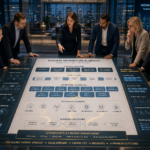
Business architecture is essential for organizational transformation. At its heart, a business architecture gives us a shared mental model of the enterprise, a way to see the whole rather than only the parts. It helps make visible how strategy, value, capabilities, people, processes, information, technology, and change fit together and depend on one another to ultimately deliver on an organization’s purpose.
Transformation requires a shared understanding; it cannot succeed when every part of the organization has their own version of the map. If we see only our functions, we optimize our functions. If we see only individual initiatives, we optimize individual initiatives. However, when we can see the enterprise as a connected whole, we can begin to ask different questions: How do we create value from end-to-end? What capabilities do we need to be good at? What needs to change? How do the pieces need to work together?
Business architecture is not the organization, but it is a model of the organization. It is a deliberate lens that helps us see what matters for the decisions we need to make. As we shape the future ahead, business architecture helps us see the organization we have, so we can imagine and design the organization we want to become.
Seeing differently is transformation.
Paradigms shape how we think, maps and models give us a way to represent what we see, and shared mental models allow people to see and act together.
Transformation starts with seeing differently, and we have a choice. The future will not necessarily fit the map we inherited, but seeing differently opens up a world of possibilities.
[i] The U.N. backs a new world map showing Africa in its true relative size,NPR, https://www.npr.org/2026/09/04/nx-s1-5958611/africa-world-map-un-vote
[ii] UN votes to adopt new world map that reflects Africa’s true size, Aljazeera,https://www.aljazeera.com/news/2026/9/4/un-votes-to-adopt-new-world-map-that-reflects-africas-true-size?utm_source=chatgpt.com
[iii] Planetary Motion: The History of an Idea That Launched the Scientific Revolution, NASA, https://science.nasa.gov/earth/earth-observatory/planetary-motion/?utm_source=chatgpt.com
[iv] LHC experiments at CERN observe quantum entanglement at the highest energy yet https://www.atlas.cern/Updates/Press-Statement/Top-Entanglement?utm_source=chatgpt.com

Whynde Kuehn is a recognized globally as a highly sought-after pioneer, thought leader, educator, and advisor in strategy execution, transformation, and the intentional and sustainable design of organizations and business ecosystems, enabled by business architecture. She has worked with an extensive array of organizations to build their capacity for end-to-end strategy execution and strategic business architecture practice, including Fortune 500 and global enterprises, governmental and non-profit organizations, social enterprises, startups, and multi-stakeholder initiatives. Whynde has decades of experience in enterprise change and strategic planning, including leading large-scale transformations.
She is founder and managing director of the global management consulting practice S2E Transformation, helping clients bridge the gap between strategy and execution, and founder of the online learning community Biz Arch Mastery. She is co-founder of the Business Architecture Guild, a board member of the Chief Architect Network, and member of the Women In Management (WIM) Global Leadership Committee. She is the author of Strategy to Reality and co-author of The Execution Challenge, and was honored with a 2025 WIM Top50 Global Award in Strategy Execution and Digital Transformation and named the 2026 Top Architecture Leader in Europe.
- Whynde Kuehn
- Whynde Kuehn

- Whynde Kuehn

- Whynde Kuehn