
“History doesn’t repeat itself, but it often rhymes.”
— Mark Twain
Every new wave of technology brings excitement and urgency, promising to transform industries and redefine what organizations can achieve. With the current rush toward artificial intelligence, I observe a familiar pattern repeating: boards ask about AI strategy, leaders feel pressure to “do something with AI,” teams brainstorm potential use cases, pilot projects appear across the organization, and questioning arises about whether real value has been achieved or what the organization is actually accomplishing. While exploration is healthy, the underlying issue remains the same: rather than starting with the future they want to create, organizations often begin with the technology itself.
I also hear, “AI is different,” and I agree, but the way many organizations are approaching it feels familiar. Technology waves may change, but organizational behavior often remains the same.
We are still challenged by technology, and now we must navigate its convergence.
Even before tackling new technologies, implementing systems effectively remains a challenge, not because of the technology itself, but because the people, process, and change factors are often underestimated or inadequately addressed. As a result, organizations often struggle to fully realize the expected benefits of technology investments. In addition, as the technology landscape becomes increasingly complex, the greater challenge is understanding the confluence of multiple technologies and deciding what to use, where, why, and how they interact.
At the same time, disruption is accelerating. This moment therefore raises an important question: are we simply chasing technology again, or are we using it intentionally to build the future business we want?
AI presents an opportunity to shift the conversation from technology to the future we want to create.
Instead of beginning with questions such as “What should we do with AI?” or “What are others doing?”, leaders inspired by the new possibilities emerging with AI should first ask: What future do we want to create? What experiences do we want to deliver to customers? What outcomes do we want to achieve as an organization? What kind of enterprise do we want to become? This perspective naturally leads to the next question: How can AI help make that future possible?
When organizations begin with the future they want to build – aligned to purpose and strategy – technology becomes a tool for realizing that vision rather than a force that pulls the organization in different directions.
Without clear business context, organizations struggle to determine where AI creates real value or to align their efforts.
In many conversations about AI and technology decisions, a critical element I often see missing is clear business context.
Without that context, leaders struggle to answer fundamental questions:
- Where will AI actually create value?
- What is the return on investment?
- How will it impact customers, partners, and employees?
- What parts of the organization must change to support it?
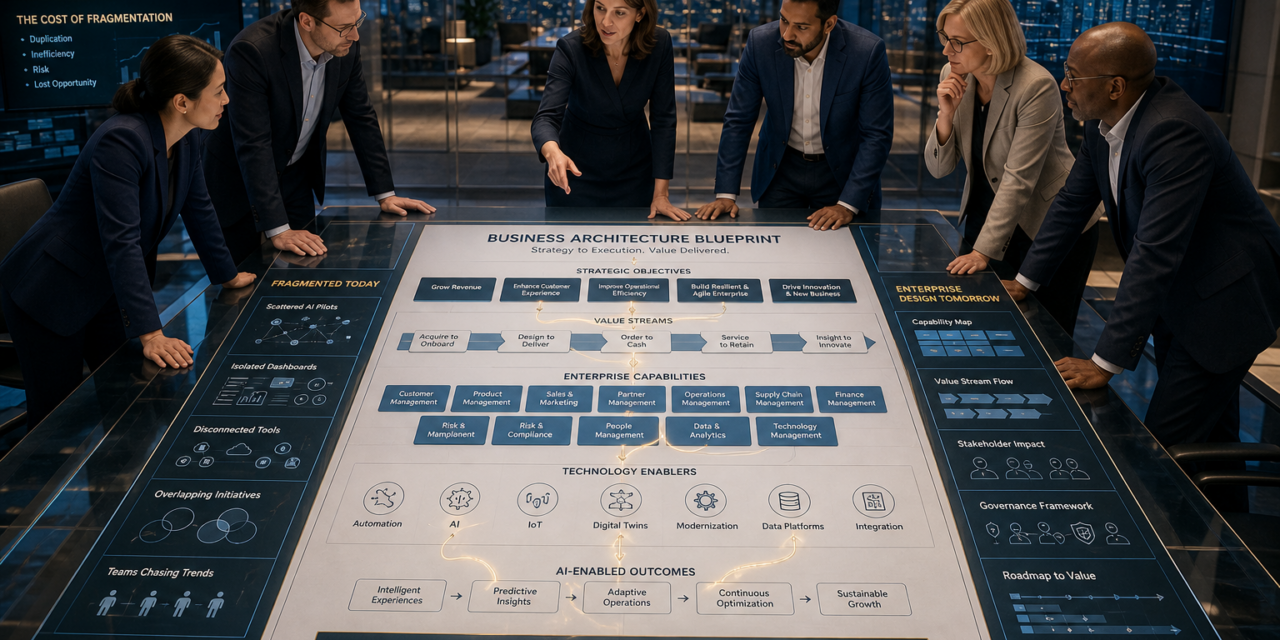
Too often, organizations attempt to answer these questions through abstract brainstorming exercises. Ideas arise from different teams and perspectives, but without a shared mental model of how they connect to business value. The result is disconnected and duplicative AI pilots, often enabling the same capabilities in isolation.
The challenge becomes even more complex as AI interacts with other technologies, such as digital twins, IoT platforms, technology modernization, and automation efforts. Without a unifying business context, leaders and teams struggle to understand how these technologies intersect, when they should be deployed, and their combined impact. In short, organizations lack a framework that connects technology decisions to strategy, business outcomes, and stakeholder impact.
Business architecture provides the missing context for technology decisions.
Business architecture provides the blueprint that connects technology decisions to the business. It offers a holistic view of an organization, showing how it is structured to create customer value and support operations. Too often, technology conversations lack this business context, leaving leaders and teams struggling to link initiatives to real business outcomes.
Value streams and capabilities form the core blueprint.
Two elements are especially powerful in guiding technology decisions: value streams and capabilities. Value streams describe how value flows to customers, partners, and employees from end-to-end. Capabilities are the reusable building blocks that describe what an organization must be able to do well to execute those value streams. Together, they form the core business blueprint that brings clarity to technology decisions.
When organizations view AI through the lens of capabilities in value stream context, the conversation changes. Instead of asking “Where can we use AI?”, leaders ask “Which business capabilities could AI enable or enhance – and to what end?” This shifts the focus from technology for its own sake to how AI can drive real value for the business and its customers.
Figure 1 shows a core business architecture blueprint, highlighting how capabilities enable multiple stages of a value stream (and across value streams). This view helps teams to see where capabilities contribute across the end-to-end flow of value creation and provides a practical anchor for linking AI initiatives to business context.
For example, the Product Information Management capability is a critical business capability, essential for delivering value in the Develop Product value stream. By examining this capability, leaders can identify where AI could add real value. AI could analyze historical product data, market trends, and customer feedback to automatically validate product specifications, recommend materials, and suggest design adjustments, helping the design team make faster, more accurate decisions, and reducing the risk of costly errors. Tying AI initiatives to capabilities in the blueprint ensures technology decisions advance strategic objectives rather than creating fragmented pilots.
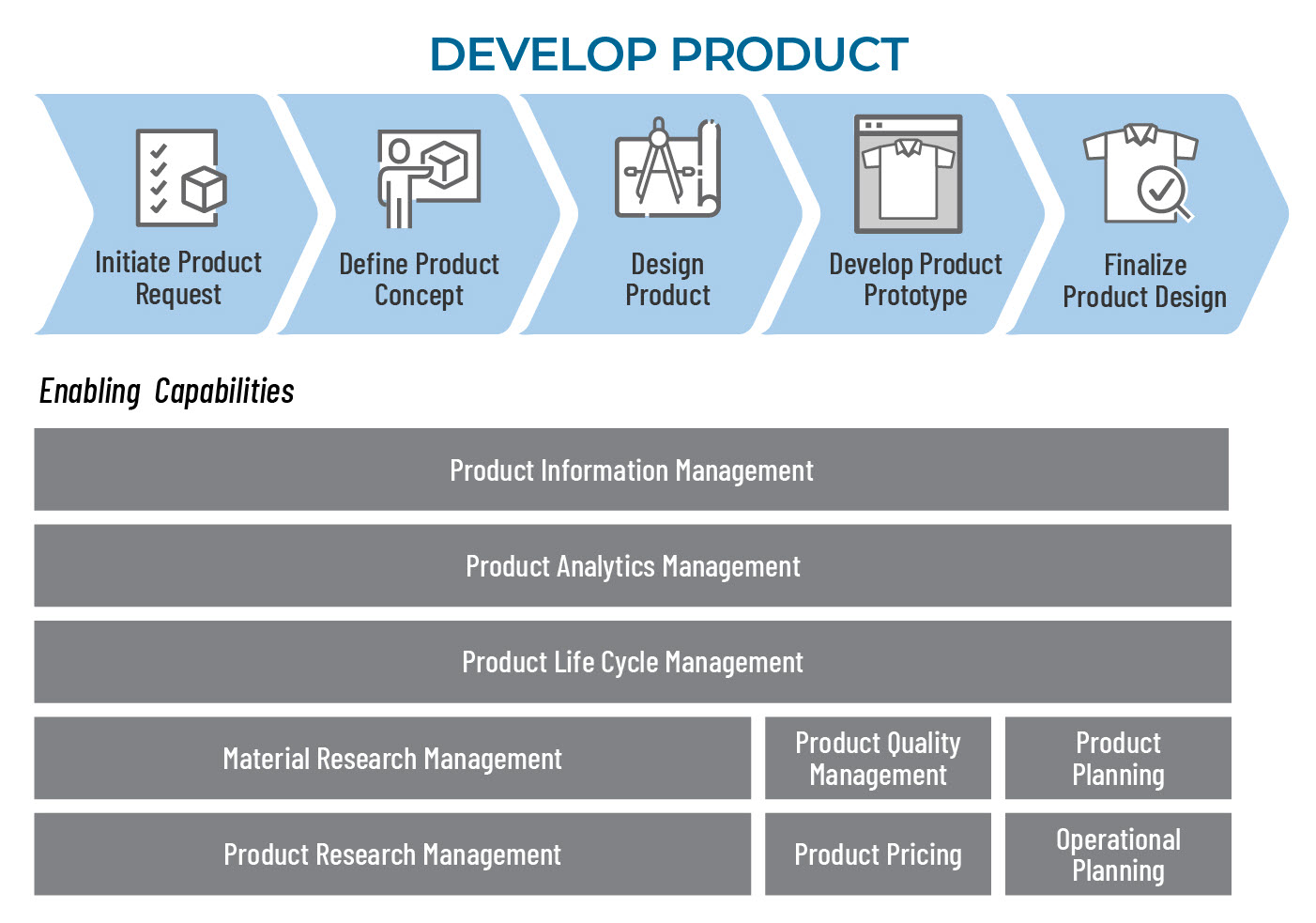
Figure 1: Core Business Architecture Blueprint for AI and Technology Alignment
Capabilities provide the golden thread from strategy to execution.
Capabilities also create a golden thread that connects strategy to execution. Strategic objectives are linked to the capabilities needed to achieve them, which in turn connect to the initiatives and solutions designed to enhance those capabilities, helping leaders see how technology investments support priorities and highlighting areas where efforts may overlap or compete for resources.
This enterprise perspective is particularly important for AI because its impact often cuts across organizational boundaries. AI-enabled capabilities may span departments, functions, and value streams. Without a shared blueprint, efforts easily become fragmented across silos. Business architecture brings those efforts back together.
It also helps organizations understand the broader implications of technology adoption. If AI significantly enhances a value stream or capability, the organization may need to redesign processes, decision-making structures, roles, and governance to fully realize the benefit. In this way, business architecture ensures that technology decisions consider the full organizational impact, not just technical implementation.
Organizations can begin applying business architecture immediately to guide AI decisions.
Moving from idea to action does not require a massive investment. Organizations can take practical steps to bring business context into technology decisions.
First, determine whether a clear business architecture foundation exists within your organization. At a minimum, organizations should establish an enterprise capability map and a set of core value streams that describe how the business operates and creates value. Many organizations can accelerate this work by leveraging reference models and collaborating with business experts across the enterprise.
Second, bring capability maps and value streams into AI and technology discussions. These artifacts provide a shared language for evaluating opportunities and allow teams to anchor conversations in how the business actually operates.
Third, map existing initiatives to capabilities. This reveals where multiple teams are pursuing similar efforts, where initiatives could be combined for impact, and where dependencies or sequencing issues exist. This approach also helps understand the collective impact of change across the enterprise, ensuring alignment with strategy and preventing fragmented efforts.
We have an opportunity to stop chasing technology and start intentionally building the future.
AI and other emerging technologies will continue to evolve at extraordinary speed. Organizations must experiment, learn, and adapt. However, experimentation and agility do not require abandoning intention.
This moment offers an opportunity to move beyond reactive technology adoption and intentionally design the future business we want to create. Grounding technology decisions in clear business context through strategic alignment, value streams, and capabilities allows organizations to move faster, realize greater value, and navigate complexity.
It is time to stop chasing technology and start building the business and world we truly want to create.
Tag/s:ArchitectureBusiness TransformationDigital Enterprise






Excellent read! It’s so easy to get distracted by shiny new tech, but anchoring transformation to your core business goals is the only way to drive real value.