
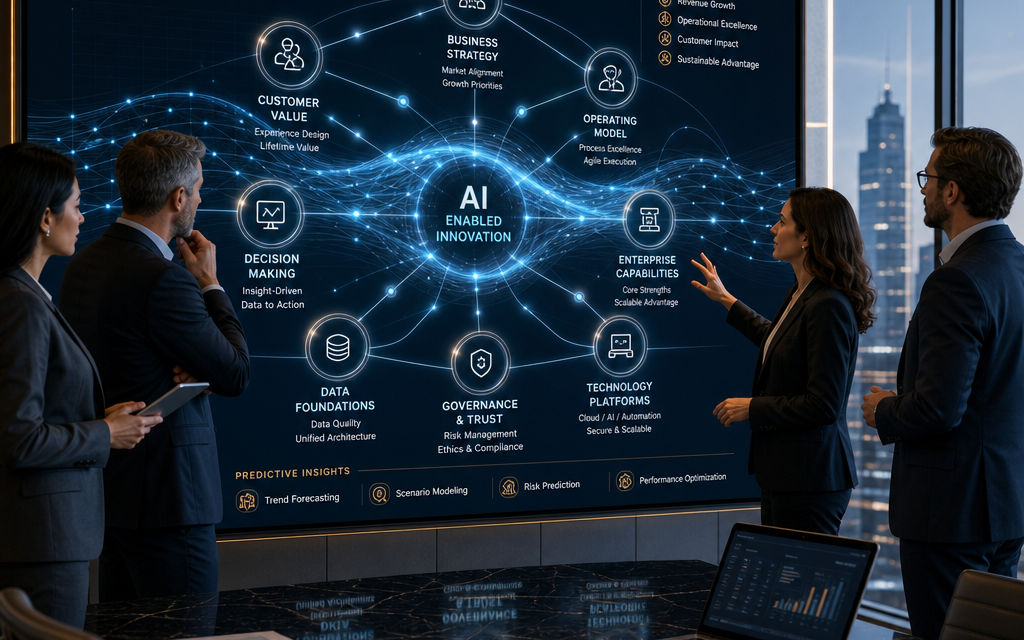
Every new wave of innovation brings excitement and urgency, and artificial intelligence is no exception. Boards are asking about it, leaders feel pressure to respond, and organizations are moving quickly to define their “AI strategy.” At the same time, I observe a familiar pattern repeating: the technology-first approach.
Too often, the starting point is, “How will we leverage AI?” and “What are others doing?” These are important questions, but they shift the focus to the technology rather than the business. This leads to teams across the enterprise launching pilots, exploring use cases, and experimenting with tools. I already see a proliferation of AI pilots in organizations that are duplicative, disconnected, and not necessarily moving the needle on real business performance or strategic goals.[1]
What is often missing is a deeper conversation and grounding back to the business strategy to focus on: Who do we want to become? What are we trying to achieve? How should the organization evolve? Without this anchor, AI efforts become fragmented and disconnected from business value.
AI strategy is not separate from business strategy, even if organizations initially treat it that way to create focus.
When something new and transformative emerges, organizations tend to create a dedicated strategy around it. For example, we have seen this with digital strategies, data strategies, sustainability strategies, and now AI strategies. These moments are often accompanied by the rise of specialized leadership roles such as Chief Digital Officer, Chief Data Officer, and Chief AI Officer.
There is value in a dedicated AI strategy which can help to create momentum, focus effort and investment, and accelerate early progress. However, it is important to acknowledge that this separation is temporary.
Over time, these standalone strategies become embedded into how the business operates. Digital is no longer separate, data cannot be treated as an isolated concern, and sustainability is increasingly integrated into core decision making. AI will follow the same path.
The end state is not an organization with an AI strategy alongside its business strategy, but rather one where AI is part of how the business functions, competes, and creates value. Even when separated for focus, AI must be defined in the broader business context.
A strong AI strategy must clearly define both where AI creates business value and what foundations are required to enable it to scale.
In practice, I see most organizations trying to accomplish two things with their AI strategies. First, they establish the foundations required to enable AI, including data, technology platforms, and governance. Second, they define where AI will be applied to create business value. This includes improving operations, enhancing decision making, and enabling new products, services, and business models.
Both areas are necessary, but they are not equal in purpose.
The value dimension is related to strategy and defines how AI changes the business, where it matters most, and how it contributes to outcomes. The foundation dimension enables that value to be delivered consistently and at scale.
Many organizations place greater emphasis on the foundational activities because they are tangible and easier to define. However, building strong foundations without clear value leads to well-architected solutions that lack purpose. On the other hand, focusing only on use cases without investing in foundations leads to fragmentation, duplication, and an inability to scale.
Leaders must manage both perspectives together and ensure they are actively connected in decision making and investments. Leaders must also have a command of AI and related technologies to engage with it meaningfully in a strategic context and understand the possibilities it creates. This is not about becoming technical experts, but about being able to see beyond efficiency and automation into how AI can enable new ways of delivering value, expand strategic options for the organization, and reshape or reimagine business models.
AI investments must be anchored in business capabilities to avoid fragmented roadmaps and disconnected use cases.
Another common challenge I see is the creation of technology-focused roadmaps that emphasize tools, platforms, and isolated use cases without a clear connection to business strategy and outcomes.
A more effective approach begins by reframing the conversation entirely. Instead of asking broadly where we can leverage AI, or which AI tools to implement, we should start with the business strategy and goals, and what they are trying to achieve in measurable terms. From there, the question becomes what does the organization need to be good at or do differently to deliver those outcomes? This shifts the focus from technology to capabilities.
Capabilities describe what an organization must be able to do to execute its strategy. They represent the high-level, reusable business building blocks required to deliver products and services and support operations, independent of organizational structure or processes.
When the AI conversation is anchored in capabilities, it shifts the thinking from “What can we build with AI?” to “What must we be able to do better and where can we leverage AI to help?”
It also shifts planning and ways of working toward a more enterprise approach. Instead of building one-off initiatives, organizations focus on strengthening and evolving capabilities across people, process, information, and technology. Capability-driven organizations plan around these enhancements and often maintain multiple coordinated strategic capability roadmaps across the enterprise to drive their strategy and transformation.
In this context, AI does not sit on a separate roadmap. It is embedded within these capability roadmaps as an enabler, alongside other technologies. At the same time, a separate but aligned enablement roadmap is necessary to build the foundations, including shared investments in data, platforms, and governance.
A practical way forward is to align business capability roadmaps with a deliberate and well-governed enablement layer.
How do we move forward, whether we are defining a new AI strategy or already in the midst of one?
- Begin by grounding AI discussions in business strategy and goals. Define what the organization is trying to achieve and who it wants to become, then allow AI to expand what is possible within that context.
- Identify the capabilities most critical to achieving the strategy and goals, ideally in the context of value streams that show how value is created end-to-end for external and internal stakeholders.
- Determine where AI can enhance, transform, or enable those capabilities. The capability lens readily highlights the value of leveraging AI in that area, the impact on stakeholders and the business ecosystem, and how it fits with other business or technology changes being planned for that capability.
- Develop a primary roadmap based on these capabilities, with AI embedded as an enabler alongside other technologies. If the organization is already capability-driven, work these enhancements into existing capability roadmaps across the enterprise.
- In parallel, define a supporting enablement roadmap covering shared foundations such as data, platforms, and governance. Treat this as an investment roadmap that enables scale, reuse, and consistency across the enterprise.
- For organizations currently focused on use cases and pilots, prioritize them based on the capabilities that matter most and align them to strategic objectives. This reduces duplication, aligns efforts, and ensures experimentation contributes to broader outcomes. It also helps surface redundancy when multiple efforts are focused on the same capability.
- Leverage business and enterprise architects as key partners. They translate strategic intent into a coherent future state, help navigate the enterprise-wide impacts of AI investments, and inform the possibilities for leveraging AI strategically.
- For organizations not yet operating with a capability-driven mindset, adopting an AI strategy is an ideal opportunity to introduce this approach while ensuring strategic alignment and improving execution.[i]
Organizations that succeed treat AI not as a separate initiative, but as part of how the business evolves and operates.
AI will continue to advance rapidly, and organizations must continue to experiment and learn. However, experimentation without direction leads to fragmentation.
The most successful organizations are not those with the most pilots or the most advanced tools, but those that clearly understand what they are trying to achieve and intentionally embed AI into how they operate.
There is one business strategy. AI is an enabler, and a capability-driven approach connects investments back to strategy and meaningful value. With the right foundations in place, AI becomes a powerful force for shaping the future of the business.
[1] As one data point, at the end of 2025, Gartner found that “at least 50% of generative AI projects were abandoned after proof of concept due to poor data quality, inadequate risk controls, escalating costs or unclear business value.” They also state that the single biggest reason GenAI projects fail is “Poor use-case selection combined with lack of business value consistently tops the list.” See https://www.gartner.com/en/articles/genai-project-failure
[i] See my article on Transforming as an Enterprise for more information: https://www.institutefordigitaltransformation.org/transforming-as-an-enterprise/
Tag/s:ArchitectureBusiness TransformationDigital Enterprise






Whynde,
Your article landed at exactly the right moment. You wrote: “The question becomes what does the organization need to be good at or do differently to deliver those outcomes? This shifts the focus from technology to capabilities.”
I have been working on a methodology that I believe provides the missing bridge you are describing — a structured way to connect process taxonomy to capability-level AI design intent, with measurable targets at every level of the hierarchy.
The Human-AI Partnership Framework introduces HITL — Human-in-the-Loop — not as a safety mechanism but as an organizational design standard. For every process in the enterprise, it defines an optimal human/AI balance, measured as a Human% ratio, and provides a five-level maturity progression showing how that balance should evolve as AI capability matures.
This week I completed something I think you will find directly relevant to your thesis. Working from APQC’s Process Classification Framework v8.0, I applied the HITL methodology to all 13 PCF categories — covering every L3 process across the framework — using a systematic verb-based derivation method that assigns HITL pattern types from the PCF’s own Level 4 activity vocabulary. The result is a complete set of maturity ratio tables, aggregated bottom-up from L3 process to L2 process group to L1 capability domain, at five maturity levels.
In practical terms, this means that for any capability an organization is investing in, there is now a measurable answer to your question: where can AI enhance this capability, and what does the progression look like from current state to optimized design intent?
This feels like a direct response to the gap you identified — AI investments anchored in capabilities, with a principled method for evaluating where human judgment must be preserved and where AI can absorb the work.
I would welcome the opportunity to share this with you directly. I believe there is a natural connection to BizBOK’s capability model and potentially a productive conversation about where the two frameworks could reinforce each other.
Warm regards,
Timothy P. King
Human Enterprise Architect
timothy.king@hitldrivenarchitecture.com
hitldrivenarchitecture.com
One aspect I found particularly meaningful is that the article reminds us that organizations succeed with AI not because they launch the most pilots, but because they clearly understand what they are trying to achieve. Strategic clarity should come before technological experimentation